
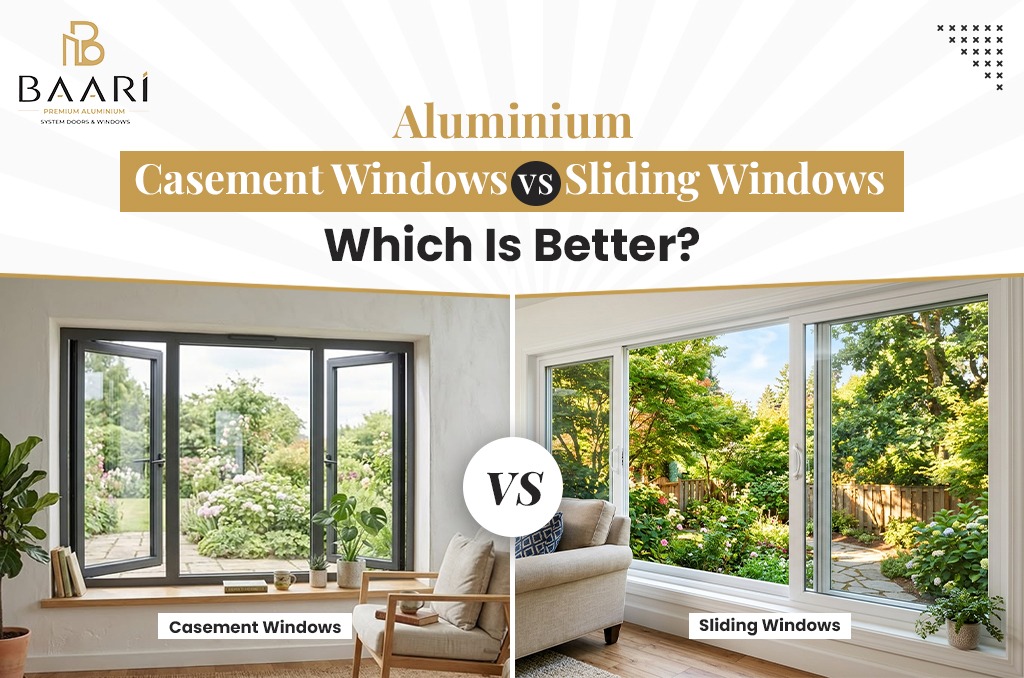
Aluminium Casement Windows vs Sliding Windows
Choosing windows for a home sounds like a small decision, but it can make a real difference to how a room looks and feels. The right windows can bring in more fresh air, make everyday cleaning easier, and help you enjoy the view outside. The wrong choice can become frustrating after you move in.
Two popular options are aluminium casement windows and aluminium sliding windows. Both have a modern appearance, both can last for years when properly made and maintained, and both work well in different types of homes.
But they are not the same.
Casement windows open on hinges, usually outward or inward, while sliding windows move horizontally along a track. This simple difference affects ventilation, furniture placement, maintenance, weather sealing, and even how you use the room.
So, which one should you choose?
The answer depends on where the window will be installed, how much space you have, how often you open it, and what matters most to you. Let's look at the differences in detail.
What Are Aluminium Casement Windows?

Aluminium casement windows are attached to the frame with hinges. Depending on the design, they can open outward or inward, much like a door. A handle operates the locking mechanism, allowing the sash to open and close.
One reason people choose casement windows is the way they open up a room. When the window is fully open, there is a large, clear opening for fresh air to enter.
They are commonly used in bedrooms, living rooms, studies, and other areas where ventilation is important.
Modern aluminium casement systems can also have slim frames, multiple locking points, and suitable weather seals. The actual performance depends on the window design, hardware, installation quality, and glass specification.
A simple example: If your bedroom gets stuffy during the evening and you want to let in more fresh air, a well-designed casement window may be a good option because its sash can open wide.
However, you need to check the space outside the window. An outward-opening sash may not be suitable next to a narrow balcony walkway or where another structure could obstruct it.
What Are Aluminium Sliding Windows?

Aluminium sliding windows work differently. Instead of swinging open, one sash slides horizontally over another along a track. Some systems have two panels, while others use three or more panels depending on the design.
Their biggest advantage is that they do not need extra space to open. This makes them useful in apartments, compact bedrooms, balconies, and rooms where furniture is placed close to the window.
Sliding windows are also popular for large glass openings because they can provide a broad view of the outside.
However, there is one detail people sometimes overlook: in a typical two-panel sliding window, one panel remains in place while the other slides. This means only part of the total window area can be opened at a time.
A simple example: If your living room opens onto a balcony and you want a wide glass view without a window sash swinging into the walkway, sliding windows can be a practical choice.
The track and rollers need occasional cleaning, especially in dusty environments. If dirt builds up in the track, the sash may become harder to move.
Aluminium Casement Windows vs Sliding Windows: Quick Comparison
Here is a side-by-side comparison to help you understand the main differences.
One important point: neither window type is automatically better in every category. A well-made sliding window can outperform a poorly made casement window, and the same is true in reverse. The frame design, hardware, seals, glass, and installation matter just as much as the opening style.
1. Which Window Provides Better Ventilation?
If fresh air is your main priority, casement windows often have an advantage.
A casement window can open across most of its sash area, depending on its configuration. The open sash can also help direct some of the passing breeze into the room.
With a conventional two-panel sliding window, one panel generally stays fixed while the other moves. So, even if the overall window is large, the clear opening is usually smaller than the total frame width.
Here is a simple illustration.
Typical clear opening comparison
Illustrative example for similarly sized windows, not measured airflow or a product performance rating.
Casement window
Up to ~90%
Two-panel sliding window
Around 50%
Actual clear opening depends on the frame, sash dimensions, number of panels and opening mechanism. The percentage shown is an illustrative comparison of opening area, not a universal specification.
Why does this matter?
Imagine a bedroom with a window facing a garden. If you want to bring in more outdoor air during the cooler parts of the day, a casement design may be worth considering.
But ventilation also depends on the direction of the wind, the size of the opening, room layout, and whether air has another way to leave the room. A large window alone does not guarantee good ventilation.
Our suggestion: Choose casement windows when a larger opening is important. Consider sliding windows when you need a practical opening but have limited space around it.
2. Which Is Better for Rain and Dust?
This is an important question for Indian homes, particularly in areas that experience heavy monsoon rain or dusty weather.
Casement windows often use compression seals. When the sash closes and locks, it presses against the seals around the frame. A well-designed system can provide effective resistance to air and water infiltration.
Sliding windows generally rely on weather seals between moving panels, along with drainage channels that allow collected water to escape. Their performance depends on how these parts are designed and maintained.
Neither design is automatically waterproof or dustproof.
For example, a sliding window with a poorly maintained drainage channel may develop water-related problems during heavy rain. A casement window with incorrectly adjusted hinges or damaged gaskets may also allow water or air to pass through.
Before buying, ask the manufacturer about:
The weather-sealing arrangement.
Drainage and water-discharge provisions.
The type and quality of gaskets.
Suitability for the building's wind and rain exposure.
Testing or performance documentation for the complete window system.
If you live on a high floor or in a location exposed to strong winds, these details deserve particular attention.
3. Which Window Is Better for Apartments and Small Rooms?

Sliding windows are often the more convenient option for smaller rooms because they do not swing into the room or outside it.
Think about a bedroom with a bed close to the window. An inward-opening casement sash could interfere with the bed, curtains or nearby furniture. An outward-opening sash might be inconvenient if the window opens onto a narrow balcony.
A sliding window avoids that particular problem.
This makes sliding systems useful for:
Apartments with compact bedrooms.
Windows beside desks or kitchen counters.
Balcony-facing living rooms.
Spaces with restricted exterior clearance.
Wide openings where a sliding configuration suits the design.
Casement windows can still work very well in apartments, especially where there is sufficient clearance and ventilation is a priority. Just check how the sash will open before finalising the design.
A useful tip: ask your window supplier to show you the actual opening direction on the floor plan. It is much easier to change the design on paper than after installation.
4. Which Window Offers Better Noise Reduction?
Many homeowners assume that choosing aluminium windows automatically makes a room quieter. In reality, noise reduction depends on several parts of the complete window.
These include the glass thickness and construction, the gaps around the sash, the quality of the seals, the frame design, and the installation.
Casement windows can have an advantage when their closing mechanism presses the sash firmly against continuous compression seals. This can help reduce air leakage paths through which sound may travel.
Sliding windows can also offer good noise performance when they use suitable acoustic glass, effective seals and a well-designed frame system. However, the sliding mechanism and meeting points between panels need careful attention.
If your home faces a busy road, consider asking about:
Acoustic or laminated glass options.
The recommended glass thickness for your window size.
Air leakage performance of the complete window system.
Sealing around the window-to-wall joint.
Tested acoustic ratings, if available.
Do not compare windows based on glass thickness alone. A good glass specification cannot compensate for significant gaps around the frame.
5. Which Is Easier to Maintain?
Both types are relatively straightforward to maintain, but they have different needs.

Casement windows
Keep the hinges, handles and locking points clean. Check that the sash opens smoothly and closes evenly. Over time, hinges or locking hardware may need adjustment, particularly on larger or heavier sashes.

Sliding windows
Remove dust, sand and other debris from the tracks. Check the rollers and drainage openings periodically. If a sash starts feeling heavy, the track may need cleaning or the rollers may need attention.
In dusty cities, sliding window tracks may need more frequent cleaning. Casement hardware, meanwhile, needs occasional checking to ensure that the sash remains properly aligned.
One point worth remembering: if you live in a high-rise apartment, make sure the window design allows safe access for cleaning. Do not lean out of an open window to clean the exterior glass.
6. Which Aluminium Window Is More Affordable?
There is no fixed rule that casement windows always cost more or sliding windows are always cheaper.
The final price depends on the size of the opening, aluminium profile series, glass specification, number of panels, hardware, finish, installation requirements and project quantity.
A casement window may require specialised hinges, locking hardware and handles. A sliding window may require suitable rollers, tracks and interlocking profiles. Large panels or premium hardware can increase the cost of either system.
Instead of comparing only the price per square foot, ask for a complete quotation that includes:
Aluminium profile specifications.
Glass type and thickness.
Handles, locks, hinges or rollers.
Weather seals and drainage features.
Manufacturing and installation.
Warranty terms and after-sales support.
For a fair comparison, ask both suppliers to quote for the same opening dimensions, glass and finish. Otherwise, a lower quote may simply be based on a different specification.
Also, consider long-term convenience. A window that is cheaper initially may not be the best choice if it is difficult to operate or unsuitable for the location.
7. Which Window Looks Better in a Modern Home?
This mostly comes down to personal preference and the design of the building.

Casement windows work well in designs that emphasise ventilation and a traditional hinged opening with a modern frame. Depending on the profile, they can provide a clean, minimal look.
Sliding windows are popular in contemporary apartments and villas, especially for broad horizontal openings and balcony-facing rooms. They can create a simple glass-heavy appearance without a swinging sash occupying space.
Both styles are available in different frame colours, glass options and finishes. The final appearance depends on the frame proportions, number of divisions, hardware and the surrounding architecture.
For a more consistent look, plan your windows together rather than selecting each one separately. A home can use casement windows in bedrooms and sliding windows in the living room without looking mismatched, provided the frame finish and overall design are coordinated.
8. Casement vs Sliding Windows: Which One Should You Choose Room by Room?
Instead of choosing one style for the entire house, think about what each room needs.
These are starting points, not fixed rules. A well-designed casement window can work in a living room, and a sliding window can work perfectly well in a bedroom.
The best choice is the one that suits the room rather than forcing every room to use the same design.
9. What Should You Check Before Ordering Aluminium Windows?
This is where homeowners can avoid some common problems.
Many people spend time choosing the frame colour and glass appearance but do not ask enough questions about what sits behind the finished window.
Before placing an order, check the following.
1. Aluminium profile series
Ask which profile series is being used and whether it is suitable for the size and location of your opening. Larger windows and heavier glass may require a different configuration.
2. Glass specification
Clear glass, tinted glass, laminated glass and double glazing serve different purposes. The right option depends on your priorities, such as daylight, heat control, safety or noise reduction.
3. Hardware quality
Handles, locks, hinges and rollers affect daily operation. They should be suitable for the weight and dimensions of the sash.
4. Weather seals and drainage
Ask how the window handles rainwater, where the drainage openings are located and how the seals are maintained.
5. Installation
Even a good window system can perform poorly if the frame is not installed correctly. Proper alignment, fixing and sealing between the frame and wall are important.
6. After-sales support
Ask who will handle adjustments or repairs if a handle becomes loose, a roller wears out or a seal needs replacement.
A window is something you will use for years. It is worth checking these details before making the final decision.
10. The Final Verdict: Aluminium Casement Windows or Sliding Windows?
There is no single winner for every home.
Choose aluminium casement windows if you want a wide opening for ventilation, prefer a hinged design and have enough space for the sash to open. A suitable casement system may also be a good option when compression sealing is a priority.
Choose aluminium sliding windows if you want to save swing space, have furniture near the window or need a convenient solution for a wide opening. They can be especially practical for apartments and balcony-facing rooms.
And if you are building a new home, there is no reason to limit yourself to just one type.
You might prefer casement windows in bedrooms, where ventilation matters, and sliding windows in the living room, where you want a wide view without an opening sash getting in the way.
Before deciding, compare the complete window specifications, not just the style or price.
Looking for the Right Aluminium Windows for Your Home?

Choosing the right windows becomes easier when you understand how the different systems work and what your home actually needs.
At BAARI, you can explore aluminium window solutions for modern homes and architectural projects. Whether you are considering casement windows, sliding windows or a combination of both, start by identifying your space, ventilation and design requirements.
Before finalising your window system, discuss the opening dimensions, glass options, hardware and installation requirements with the manufacturer.
Planning a new home or renovation? Visit the official BAARI website to explore aluminium window solutions and find an option that fits your project